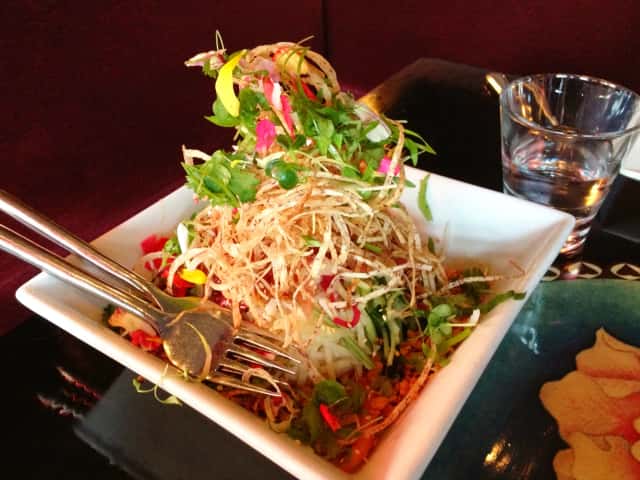
Split The Meal Around The Belt Noodle
Make Four Foot Belt Noodle the shared centerpiece, then bracket it with Stuffed Chicken Wings and Shrimp Toast so the meal has crunch, richness, and a dramatic noodle anchor without over-ordering too many mains.
First time here? Take the 30-second tour of how Restaurantica works!
A single noodle four feet long lands in the middle of the table and reorganizes the meal around it. That dish — the Four Foot Belt Noodle — is the clearest signal of what Mimi Chinese is after on Davenport Road: regional Chinese cooking rebuilt for a polished dining room, where plates are meant to be pushed to the centre and shared. The restaurant comes from Big Hug Hospitality, and it treats classic references as a starting point rather than a checklist, moving across cold plates, seafood, noodles, and rice without ever settling into generic-takeout shorthand.
The menu rewards a table that orders with intent. Stuffed Chicken Wings and Shrimp Toast are the small-plate anchors, compact and crisp and built to open a meal alongside a drink. Smacked Cucumber Salad brings a cold, sharp counterpoint; Stir Fried Rice Rolls carry the noodle-and-rice register. From there the kitchen moves into seafood with ambition: Hunan Chili Sea Bass, Black Bean Amberjack, Lobster and Shrimp Fried Rice, and Chaoshan Marinated Scallops. Char Siu Ribs and Iberico Pluma Char Siu handle the pork side, while Yu Xiang Eggplant and Steamed Broccoli with Mock XO give the vegetables their own reason to be ordered.
What that spread says about the kitchen is that it is confident enough to be specific. A restaurant hedging its bets fills the menu with interchangeable dishes that could come from any address; Mimi does the opposite, staking its identity on a handful of plates distinctive enough to plan a dinner around. Honey Walnut Shrimp and General Tao Chicken nod to the familiar end of the canon, but they sit beside Chaoshan Marinated Scallops and Iberico Pluma Char Siu, which do not. The regional range — Hunan heat, Chaoshan marination, Cantonese char siu — is filtered through a refined dining room rather than flattened into a single house style.
Sharing is the operating premise, not a suggestion. A good order spreads a few registers across the table at once — a cold plate and a couple of small plates to start, a seafood dish and a noodle through the middle, a vegetable to round it out — so no one is locked into a single main. It is why Mimi works as easily for a group splitting a spread as for two people building a smaller version of the same idea. The kitchen has clearly thought about how a table actually eats, and the menu is arranged to reward ordering across it rather than down a single column.
The kitchen is led by chef Braden Chong, and the restaurant sits within Big Hug Hospitality, the group founded by David Schwartz and Brandon Marek. That backing is what lets Mimi run more than one service at a time. A bar-only happy hour fills the early hours Tuesday through Thursday, from open until seven; a late-night menu takes over Thursday through Saturday after nine, trimmed to a shorter list for a later table. Private events and larger group bookings route through the group as well, which makes the restaurant a workable pick for a celebration and not only a quiet two-top.
The bar is not an afterthought bolted onto the food. Cocktails, wine, sake, and a baijiu leaning give the meal a second track, so an evening can begin as drinks and small plates and drift into a full dinner — or stop short of one on purpose. Mimi has been recognized in the Michelin Guide and named to Canada's 100 Best for the version of regional Chinese it has settled on, and the recognition tracks a simple decision: this is a kitchen that chose the handful of dishes it wanted to be known for and then made the rest of the night rearrange around them.
Mimi turns regional Chinese references into a refined shared-plate dinner with strong named dishes.
Cocktails, happy hour, and a Thursday-to-Saturday late-night format give Mimi more than one way to visit.
Shared dishes, private-event materials, and guide recognition make the restaurant a practical celebration pick.
This is Restaurantica’s own read — synthesized from publicly available sources across diner signal and editorial research, last updated July 2026. It’s our interpretation of the evidence, not a crowd average — and placement is never for sale.

Braden Chong gives Mimi a clear chef-led point of view: polished regional Chinese dishes, guide-recognized technique, and menu anchors that feel specific to this room rather than interchangeable across the city.

Mimi has unusually memorable signature dishes: Four Foot Belt Noodle, Stuffed Chicken Wings, Shrimp Toast, and Smacked Cucumber Salad make the meal feel planned around named plates.

Mimi is not only a food-first room; the bar program gives the meal another lane, with cocktails, wine, sake, and non-alcoholic options that support a longer night out.

The restaurant is set up for more than a two-top dinner, with private-event materials and group-booking guidance that make it a practical pick for celebrations and corporate meals.

The Thursday-to-Saturday late-night format gives Mimi a second mode after the main dinner rush, turning the restaurant into a sharper option for later shared plates and drinks.
Restaurantica’s write-up above is synthesized from broad public signal — community reviews add the first-person layer. Share the nuances of your visit to Mimi Chinese in Toronto: the standout dishes, the room, the service.
Write a reviewYes. Mimi has a polished room, a strong drinks program, and enough signature dishes to feel occasion-worthy without needing a very large group.