Augusta and Louise were the names of two late farmers, and the café that carried them turned a corner of downtown Guelph into a family breakfast. The Augusta Louise Cafe and Bistro ran as a family effort on the Carden and Macdonell blocks, close to the core and small enough that its regulars learned the menu by heart. It billed itself as both a café and a bistro, but the identity that stuck was the first one — a breakfast counter where the appeal was a short list of plates a regular could order without opening the menu. The name did the first work of introduction: before anyone read a word of the food, the sign already said this was somebody's family.
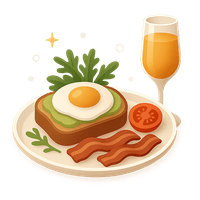
The plate that anchored the menu had the café's own name on it. The Super Cavan brought together hashbrowns, peameal bacon and fried tomatoes — a full Canadian breakfast handed a house title, so that ordering it meant ordering the café itself. Around it sat the rest of an all-day breakfast: eggs Benedict, blueberry pancakes, French toast, a vegetarian omelette, potato pancakes. Peameal bacon turned up on its own as well as inside the Super Cavan, and apple-blueberry pie and fresh coffee held down the house-baking end. None of it strayed far from the familiar — breakfast food, cooked in quantity and served without ceremony — but the café's own name on the main plate gave the menu a centre of its own. The portions ran substantial and the prices stayed low, which made a complete breakfast, not a fast coffee, the reason to come.
What set that breakfast apart was where it reached. The Super Cavan and the potato pancakes took a format most Canadians already knew and threaded a specific family history through it — the potato pancakes especially, described as an embellished hash brown, a European note folded into a plate nobody would mistake for foreign. That thread ran back through the family behind the café to a tavern once kept in Slovenia, and it gave an ordinary breakfast a lineage more particular than a downtown café usually claims. The family in that story belongs to its past; what carried onto the plate was the accent, not the biography — a potato pancake in Guelph with a Slovenian tavern somewhere behind it.
For a diner, the café earned its keep on price and plenty more than on ceremony. The menu sat at the inexpensive end, and the plates ran large enough that ordering broadly stayed easy on a budget — the value case was a full house breakfast rather than a handful of small items. The kitchen kept range for a mixed table, too: avocado toast, a veggie wrap and a daily soup gave vegetarian, vegan and gluten-free diners something past a side dish, and the all-day format meant breakfast did not close at a set hour. The setting matched the food — a small downtown storefront with a historic streak and an unhurried pace, the kind of place a neighbourhood remembers for one particular plate rather than for its volume.
For now, the doors are dark. The café is marked temporarily closed, and no reopening notice has turned up, so everything here reads as an account of what the place was rather than a promise of what it serves this week — the menu, the hours and the family framing all belong to its documented run rather than to next Saturday. Anyone drawn in by the story is better off confirming the café has reopened before making the trip. If the lights come back on, the Super Cavan is the order that would tell a newcomer the most in one plate: the café's name, its family, and its whole idea of a full breakfast, carried on a single serving of hashbrowns, peameal and fried tomatoes.